
Universities are meant to be spaces where ideas are contested, authority is questioned, and justice is debated. When those very spaces begin to resemble fortified zones, something fundamental has shifted.
At Jawaharlal Nehru University (JNU), that shift became visible in late February 2026.
The immediate trigger for the unrest was not a national policy, but a campus issue. Last year, the university administration introduced a disciplinary manual called the CPO Manual, prescribing suspension and heavy fines for students involved in protests. Two months ago, students demanded improved library facilities. When their requests went unmet, tensions escalated. In an act of protest, JNUSU, with the support of students, removed an entry authorization device—similar to a metro gate—installed at the library entrance. This device had been introduced despite continuous opposition from students, who viewed it as a form of surveillance and a breach of privacy.
Invoking provisions from the new manual, the administration suspended four office bearers of the Jawaharlal Nehru University Students’ Union (JNUSU), elected by nearly eight thousand students. The suspensions sparked widespread anger on campus.
Students began a sit-in protest raising several demands, among which three were central: restoration of equity provisions in UGC regulations, implementation of the Rohith Vemula Act to address caste-based discrimination in higher education, and revocation of the rustication of JNUSU office bearers. During the first phase of the protest, a march was organised. According to JNUSU statements, tensions escalated when members of the Akhil Bharatiya Vidyarthi Parishad (ABVP), the student wing affiliated with the Bharatiya Janata Party (BJP), allegedly threw stones and attacked protesters with sticks on the night preceding the march.
The protests intensified after the Vice-Chancellor, responding to a question about UGC regulations in an interview and a podcast appearance, made remarks that many students described as casteist and deeply offensive. She reportedly stated that “Dalits consider themselves permanently affected” and compared their position to what she characterised as “permanent victimhood” among Black communities in the United States. In another reported comment, she suggested that “Dalits and Blacks are drugged with victimhood.”
The remarks caused outrage among students, faculty, and activists across the country. Many progressive student groups have been advocating for stronger implementation of UGC equality regulations and have welcomed them as necessary safeguards. For them, the Vice-Chancellor’s comments were not merely controversial—they were symptomatic of a deeper resistance to institutional reform. They demanded the resignation of Vice-Chancellor Santishree Dhulipudi Pandit.
Students demanded a public apology and her resignation. When she did not meet them for over a week, the protests expanded.
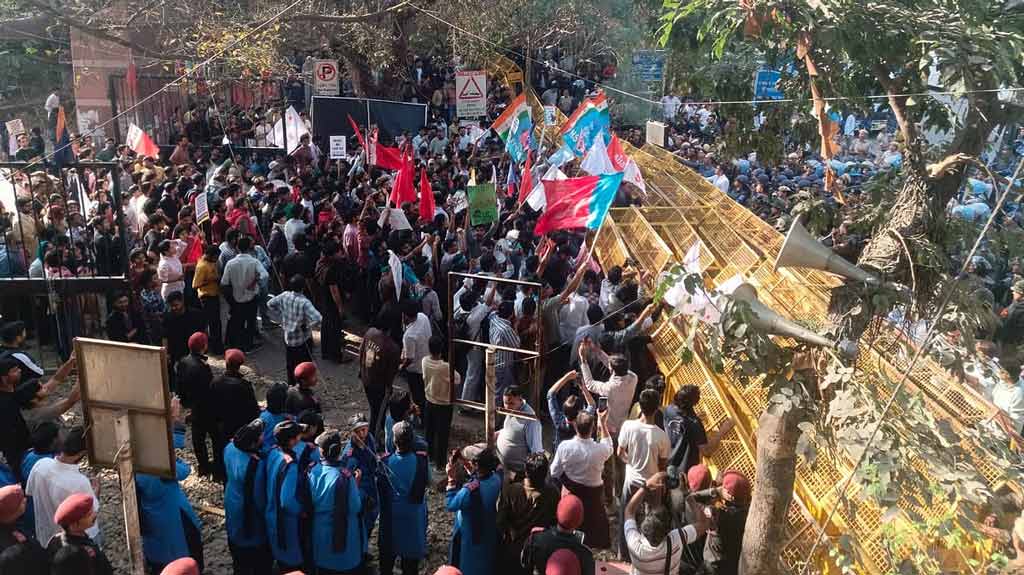
On 26 February 2026, JNUSU called for a “Long March” to the Ministry of Education. But what unfolded at the JNU Main Gate was not a march—it was a blockade.
By afternoon, multiple layers of barricades had been erected. Personnel from the Delhi Police, Rapid Action Force units, paramilitary forces, sniffer dogs, bomb squad teams, and senior officials were deployed. The gates of the university were reportedly chained and locked with three locks, preventing students from leaving the campus. Students attempting to proceed toward the Ministry were stopped at the main gate and, according to protestors, brutally attacked by the police. Videos circulated portraying students being kicked, and it was reported that the Joint Secretary’s leg was broken. Student leaders claimed that several protesters were injured.
Protesters further alleged that the police response was disproportionately forceful. Videos circulating on social media appeared to show students being dragged, detained, and, in some instances, trampled while attempting to cross barricades. Several female students were among those detained, including three women holding key union positions. Among those detained were JNUSU President Aditi, Vice President Gopika, Joint Secretary Danish, and former President Nitish. More than forty students were reportedly detained, and fourteen were formally arrested and sent to Tihar Jail.
A magistrate court subsequently granted bail to the fourteen students. However, the release process has reportedly been delayed due to residential address verification requirements—particularly affecting students from outside Delhi—and the timing of judicial holidays for Holi. As a result, they may have to wait nearly seven days for release. Student groups described the situation as “liberty on paper, jail in reality.”
One moment during the confrontation acquired symbolic weight. Students alleged that a police officer damaged a portrait of B. R. Ambedkar that protesters were carrying. According to students, it was done by senior police officer Atul Tyagi, and they claim to possess video evidence.
Ambedkar, principal architect of the Indian Constitution and a lifelong advocate against caste discrimination, represents for many students the constitutional promise of equality. To damage his image during a protest centred on caste justice was seen not just as an act of force, but as an affront to the very ideals being defended.
The incident triggered further outrage on campus.
Students have also raised concerns about what they describe as unequal policing. They argue that while Delhi Police acted decisively against JNU protesters, similar firmness has not been applied in instances where ABVP activists allegedly engaged in violence, including prior confrontations at Delhi University and earlier incidents within JNU itself. Some students also claim that previous protesters at Delhi University demanding UGC implementation were attacked inside a police station.
They further argue that after the BJP became the ruling party in Delhi, the brutal attacks on students have increased.
These claims have intensified a long-standing debate about the relationship between campus politics, state power, and partisan influence in India’s universities.
For many observers, what happened at JNU is not just about a disciplinary manual, a library gate, or even a controversial remark. It is about how institutions respond to dissent.
When students marching within their own campus are met with layered barricades, chained gates, and mass detentions, the optics are difficult to ignore. When calls for equality are answered with police force, the question shifts from campus governance to democratic culture.
Universities are meant to be laboratories of debate. If protest itself becomes grounds for suspension, arrest, and imprisonment, then the conflict is no longer merely administrative.
It becomes constitutional.
Because when students asking for justice are met with jail, the issue is no longer about one Vice-Chancellor, one regulation, or one protest. It is about the health of democracy itself.
State Coordination Committee,
Revolutionary Students – Youth Front (RSYF),
Tamil Nadu – Puducherry.
9444836642
Follow us on social media:
WhatsApp, X (Twitter), Facebook, YouTube, Telegram, Instagram